
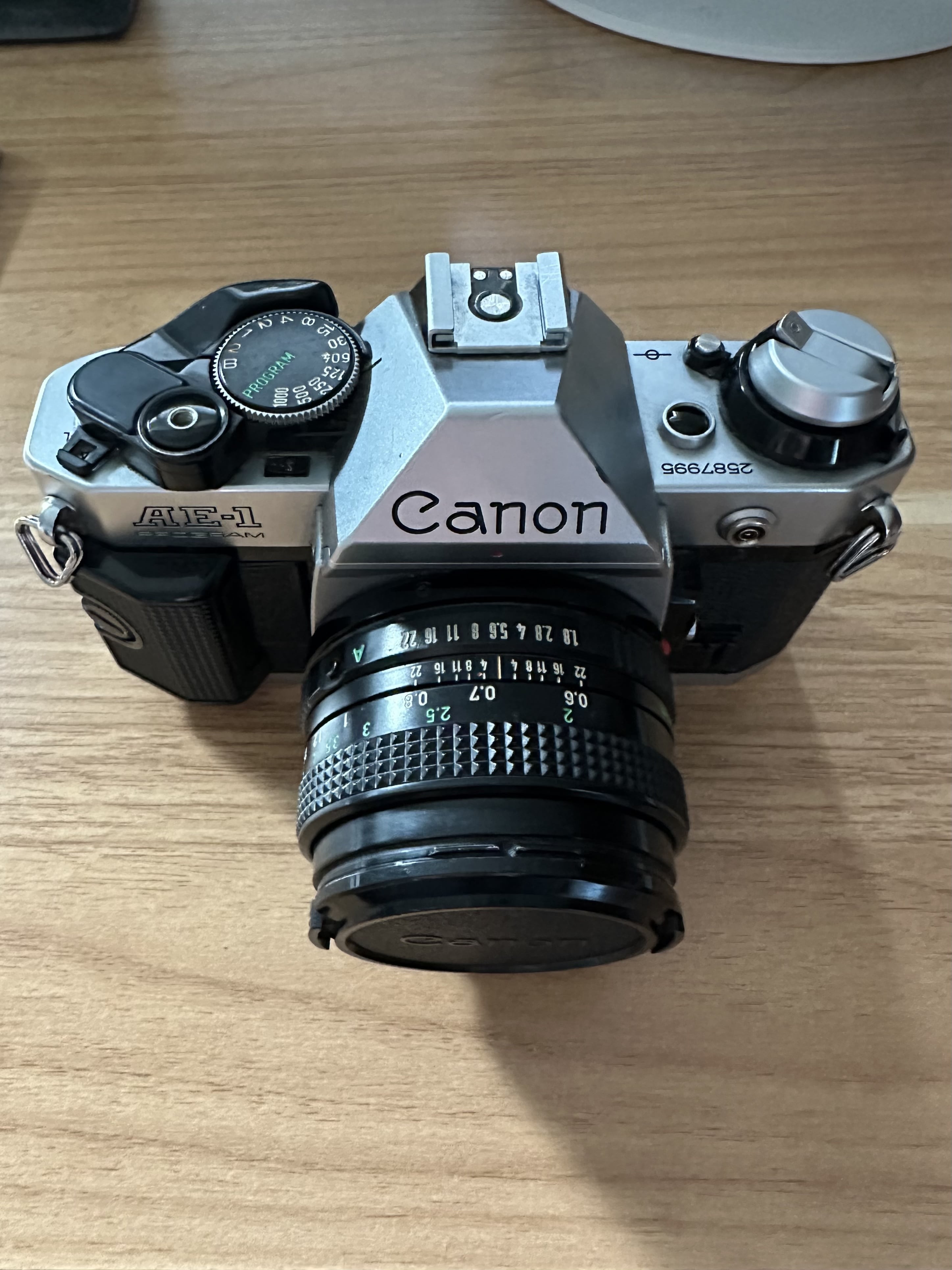
I didn’t expect to fall in love with the Canon AE-1 Program as much as I did. I had already been shooting with a starter film camera for several months, so how different could another beginner-friendly model really be?
However, after a year of shooting solely with this camera (and having it by my side through life’s ups and downs), I can confidently say that this is an amazing film camera, not just for beginners but for anyone who loves shooting film.
So, here is my Canon AE1 Program review. The good, the bad (if you can really call it that), and well, a few of my thoughts as always.
Ok, so backing up because you know I love a story.
My journey with the AE-1 Program started the same year as my Pentax K1000 (you can read my review on that camera here). On yet another San Francisco thrift haul, I picked up this camera (along with a bag and some lenses) for about 56 bucks.

After collecting dust on the shelf for several years, I decided it was time to do something with the cameras I had been gathering. After learning the basics on my Pentax, I was ready to graduate to the next camera in my collection, the Canon AE-1 Program.
The great thing about this camera is it is considered a starter film camera in the sense that it doesn’t have a ton of bells and whistles, but, it’s not so bare bones that you get bored of it easily. I’m getting ahead of myself though.
I started taking this camera out on day trips and then, when the opportunity came to relocate to Belgrade, Serbia in 2023, I had an important decision to make. Out of the nine cameras in my camera collection, which ones would make the cut to go with me for my year abroad?
Well, you can probably guess at least one of them that made the cut. I decided to go with the Canon AE-1 as I wanted a camera that felt approachable and would allow me to continue improving my photo skills without feeling completely overwhelmed (I’m looking at you, rangefinders). Not to mention, I also had a variety of lenses for this camera which would give me the ability to switch things up if I wanted to.

But let me tell you, this camera didn’t just come along for the ride—it was the ride-or-die. Eleven months, thirteen countries, and countless moments later, this camera has (literally) seen some sights. It’s documented my travels, yes. But more than that, it’s documented some of the most intimate parts of my story and that—well, that’s just special.
Alright, let’s get onto the Canon AE-1 Program review.
Canon AE-1 Program Review


Pros
Simple Interface
As a starter film camera (a 35mm SLR to be precise), there really aren’t too many bells and whistles on the Canon AE-1 Program. But don’t let its simplicity fool you—this camera packs a punch!
Ok, so what are its main features?
Standard Features
Rewind knob
Used to load or unload the film. The rewind knob holds the roll of film in place and allows you to release and rewind the film when you have finished a roll.
ASA (ISO)
The ASA on this camera ranges from 12 – 3500.
*Tip – set your ASA to your film box speed (ie – if you are shooting with Kodak Gold 200, set your ASA to 200 and leave it there for the entire roll).
Advance lever
Advances the film (shocking, I know) so you can take your next photo.
Shutter button
Opens and closes the camera’s shutter (aka the button that allows you to capture a photo). If you hold the shutter button half way down and look through the viewfinder, you’ll notice a couple of red symbols flash across the bottom of the screen. One of the extra features in this camera is its built in meter and these symbols indicate the exposure levels based on your current settings (but more on this feature in a minute).
Shutter lock
This feature is noted by the letter L next to the shutter button and allows you to lock the shutter so no photo can be taken. I found this to be very helpful when I had advanced the film, but then decided that I wasn’t quite ready to take the next shot.
Film counter
Displays the number of photos taken. Although many film stocks advertise 36 frames, the Canon AE-1 counter goes up to 38. Some photographers squeeze in an extra frame or two when loading the roll and hey, you never know—that 37th shot might just be your best one yet!
Shutter speed dial
The shutter speeds range from B (bulb which essentially just holds the shutter open for as long as you press the shutter button) to 1/1000th of a second. One unique thing about the Canon AE-1 Program is that it also has (get this) a Program mode. This mode means the camera will automatically set your shutter speed for you which is a great feature for those just starting out as it allows you to focus on other aspects of taking the photo.
Memo holder
Located on the back door of the camera, the memo holder is designed to hold the end of your film box. This was intended to remind the photographer which film stock was loaded into the camera. Nowdays, so much is digital (for instance, I keep a lot of film notes on my phone), but I still love this feature as it’s kind of nostalgic and I honestly just love the look of it.
Battery chamber
On the front side of the camera is the battery chamber. The Canon AE-1 Program requires a 6V batttery (I recommend this one) in order to work so be sure to check the battery chamber if your camera isn’t functioning.

Extra Features
On top of the standard features, there are a few extra features that make the Canon AE-1 Program unique while still keeping it very approachable and user friendly.
Multiple modes
When shooting with the AE-1, you have three options.
- Fully automatic – simply shoot and the camera will do all the work.
- Shutter priority – the camera will choose your shutter speed for you, but you’ll still have to adjust your aperture yourself.
- Manual mode – you are in complete control of your camera’s settings.
I mostly shot in manual as that was my goal for shooting overall, but it’s nice to have the option to switch either the Aperture or Shutter speed to automatic, especially when you don’t want to risk losing an epic shot.
Built–in light meter
Like I mentioned before, this camera has a built in light meter. I didn’t initially use this feature as it requires a separate set of batteries in order for it to work and, at the time, I didn’t have them on hand. But, once I started using it, I was wishing I had started using it from the beginning!
The light meter is so helpful for exposing your images correctly and having it in the camera eliminates the need for an external light meter. Seriously, don’t sleep on this feature like I did!
Hot shoe for flash
I started to play around with flash photography toward the beginning of my year abroad and it was a lot of fun but, at the time, I was still learning how to expose my photos propertly and the flash just felt like an extra step I didn’t need, so I put it aside for a while. This is something that I would like to pick back up though, so stay tuned for future updates on this topic. 🙂
Self-timer
I only used this feature a small handful of times, but it is a neat one to have and one I definitely plan to try out more in the future. As you can probably tell, I still have a lot to explore out when it comes to film photography and that’s honestly what makes this camera so perfect for beginner film photographers.

50 mm lens
Earlier I mentioned that my camera kit came with other lenses, but if I’m being honest, I almost never shot with anything other than the standard 50mm most of the Canon AE-1s come with. I eventually picked up a 35-70mm zoom lens to give myself more variety for my travel and landscape photos, but the kit lens is great and there is really so much you can do with it!
Easy to Use
Most of the features on this camera are pretty standard features you’ll find on any SLR film camera. That simple fact makes this camera so easy to use and fairly intuitive to learn even if you don’t have any prior photography experience.
Having shot a bit on the Pentax K1000 prior, this camera was definitely easy for me to use right from the get go, but if you’re still unsure about how to use it, you can always start with the automatic modes the camera offers.
Approachable (But Not Boring)
Like I mentioned earlier, this camera had just enough features to feel accessible, but not boring once I got the hang of it. While I only shot with it for a year (sadly, I no longer own this camera), I definitely did not feel like I had explored all of its possibilities when the time came to part with it.
Durable
Coming in at 575 grams (or 20.3 ounces), this camera ranks fairly light on the film camera spectrum. I found it to be both sturdy and durable and I personally felt that it was a good size for the type of traveling I was doing. It easily withstood being tossed into my bag or the occasional bump or bang.
Cons
Honestly, I cannot think of many cons for this camera (annoying, I know). My only real complaint isn’t even about the camera itself. At times, I found myself wanting a wider aperture, which is more of a lens issue than a camera flaw.
On occasion I also felt that the camera was a tad bit weighty and pulled at my shoulder or neck, but this usually happened when I was traveling and had the camera around my neck for an entire day. It’s definitely not the heaviest camera on the block, so I can’t really even say this is a con – it’s just something I experienced from time to time.
Looking back, even though I only shot with this camera for a year, it had everything I needed—and it remains to be the best film camera for beginners that I’ve found.
Even now, after switching to my Nikon F2AS, I still miss my Canon AE-1 Program. Don’t get me wrong—the Nikon is incredible, but we’re still getting to know each other. The Canon AE-1, though? That camera just felt comfortable and familiar—like coming home to an old friend.
It may not be the flashiest camera on the block, but it’s easy-to-use, approachable, and fun.
This camera made learning film feel approachable rather than intimidating and I would recommend it to anyone, but especially to those just starting their film photography journey. The Canon AE-1 is a tried and true classic and a camera that you’ll likely find yourself reaching for time and time again.

Thanks for reading and I hope you found this Canon AE1 Program review helpful!
Have you shot with the Canon AE-1 before? Let me know what you think about it in the comments!

Leave a Reply